The digital divide – what is it?
The digital divide is a term that describes how certain people and communities are excluded from access to the internet and the online services that most of us take for granted.
There are several reasons why people are excluded from the digital world. These include:
- not being able to afford a landline or broadband
- not being able to afford a computer, tablet or smartphone
- not being aware of what technology can do to improve our lives
- not having the relevant skills to use the technology
Shocking statistics
It can be shocking to look at the numbers of people and households who are digitally excluded. However if we think about some of the deeper causes of the digital divide, these figures are not really that surprising.
Poverty is one of the markers of digital exclusion. A lot of people have to make stark decisions about how they spend their money, and if it comes down to a choice of heating your home and buying food or paying for a landline it’s then easy to see why the digital divide exists.
Digital exclusion is a new form of social deprivation, exacerbated by existing lines of inequality and poverty, and as the world gets ‘smarter’, the divide gets wider. (Dr Gemma Burgess)
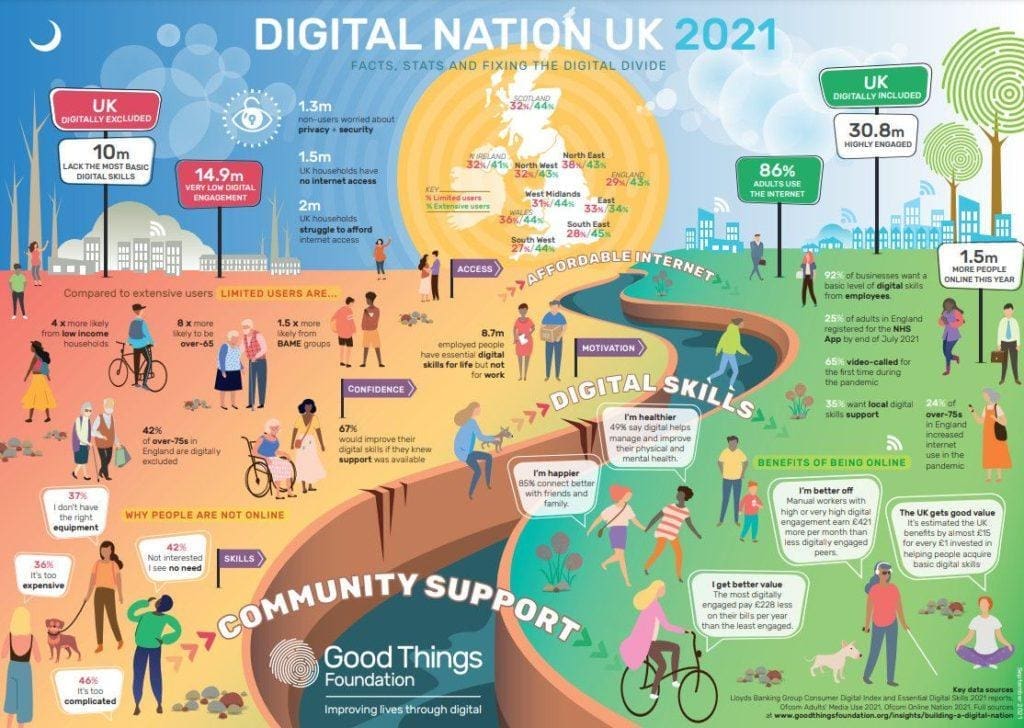
- 10m people lack the most basic digital skills. (Lloyds Bank UK 3rd Essential Digital Skills Benchmark 2021)
- 1.5m UK households have no internet access. (Ofcom, Adults’ Media Use and Attitudes).
- 2m UK households struggle to afford internet access. (Ofcom, Affordability of communications services 2021).
- 14.9m people have very low levels of digital engagement.(Lloyds Bank Consumer Digital Index 2021).
This fabulous graphic by Good Things Foundation shows more of the stats:
The Digital Divide and Disability
The ONS survey ‘Exploring the UK’s digital divide’ released in 2019 noted that ‘across all age groups, disabled adults make up a large proportion of adult internet non-users.’
They reported that in 2017 56% of adult internet non-users were disabled when at the time disabled people were estimated to make up 22% of the population.
Covid-19
The digital divide has become even more of a problem since Covid-19 because access to technology and the internet has become more important in our daily lives.
So much of modern life is now conducted online, for example access to health advice and medical appointments, government and local authority services, utilities, support services, job applications, social media – the list goes on.
A parliamentary report at the end of 2020 stated that the digital divide was even more concerning during the pandemic as people became more reliant on the internet for access to health information and services. https://post.parliament.uk/covid-19-and-the-digital-divide/
The pandemic, lockdowns and restrictions meant that we have all been missing seeing friends and family, but people with disabilities and learning disabilities were much more likely to experience feelings of loneliness and isolation even before the pandemic because of barriers to inclusion. While those of us with access to the technology to make video calls with loved ones were able to benefit from that connection, those without access were left feeling more isolated.
Digital accessibility devices – Zetetick’s ‘Alexa’ project

Zetetick has been very aware of the problems caused to our tenants and people with learning disabilities by lack of internet access.
At the beginning of 2021 we received funds from Lambeth Council’s Digital Inclusion Fund to set up our ‘Alexa’ pilot in the borough. Working with support staff from Frontier Support Services and specialist digital skills trainers ClearCommunityWeb, we have provided some of our tenants with the latest Echo Show (which has a screen), and landlines and broadband where tenants didn’t already have them.
The Echo Show has lots of benefits for people with learning disabilities. It can make video calls so helps people to keep in touch with friends and family and so reduce feelings of isolation and loneliness. Having the screen also means that people can watch things like cooking videos to encourage learning life skills as well as access TV and entertainment. Its calendars, reminders and lists can help people organise their days and medication, and write shopping lists.
Is your organisation looking to expand its CSR programme?
We want to roll out our Alexa project into other areas and benefit as many tenants as possible but we need help to do this.
Please get in touch if you can help in any way.
More about our Alexa pilot here: https://zhc.org.uk/virtual-assistants-the-voice-of-digital-inclusion/
Donate here: https://www.totalgiving.co.uk/appeal/smartmoney
EV

 Sussex Charity Walk: Join Hike4Homes 2026
 Giving: experience the joy of giving for free
 Charity Donations | 3 reasons for bountiful giving
 Life partners - Rosie's story
 Farewell and a happy retirement to Judith Chambers